
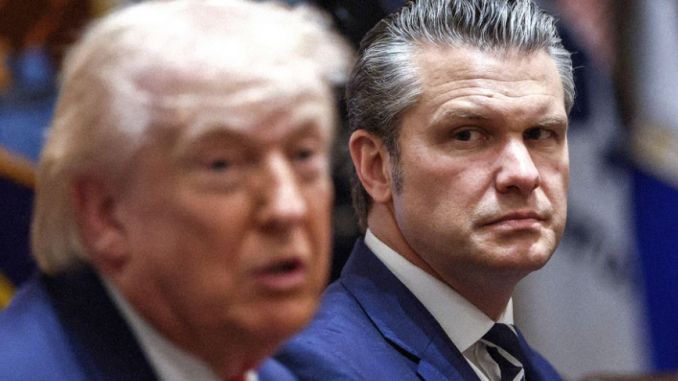
With the conflict in Iran splitting the Maga base, Hegseth is a unifying figure for Christian nationalists
Over the Easter weekend, following the dramatic rescue of an American fighter pilot deep inside Iran, the US secretary of defence Pete Hegseth compared the mission to nothing less than the resurrection of Christ. “You see,” he told reporters on 6th April. “Shot down on a Friday, Good Friday; hidden in a cave, a crevice, all of Saturday, and rescued on Sunday. Flown out of Iran as the sun was rising on Easter Sunday. A pilot reborn, all home and accounted for, a nation rejoicing, God is good.”
It was hard to imagine that Donald Trump started the war with Iran for high and holy purposes, even before he threatened to annihilate a whole civilisation. The containment of Iran, nuclear and otherwise, was surely one of the many aims in play. But as far as US economic and strategic interests go, the conflict has already proven disastrous while, in the absence of any credible plan, regime change amounted to wishful thinking at best.
And as the war drags on, it is clear that for Trump the principal aims have become as much about domestic as global politics. His Maga coalition appears to be fracturing, with a clear anti-war faction emerging, and his approval ratings are falling. He wants to shore up support among the base, a disproportionately large number of whom are supporters of Christian nationalism.
And this is where religious messaging comes in. It is designed to appeal to that part of his base, and those religious leaders who command a voter turnout apparatus that makes the Christian right a powerful bloc. Some of Trump’s most prominent evangelical supporters are framing the Iran conflict in religious terms. Jackson Lahmeyer, the founder of Pastors for Trump who is running for Congress in Oklahoma, reportedly told his congregation that wars, including the war in Iran, are typically battles between good and evil. Sean Feucht, a Trump-aligned pastor, referred online to “the end-time open doors of what [God] is going to do in Iran when this regime is prayerfully removed.”
And a good number of Donald Trump’s supporters do see him as a sacralised figure. In a recent Easter event with Trump, Paula White-Cain, senior adviser to the White House Faith Office and a longtime adviser to the president, compared him to Jesus. “You were betrayed and arrested and falsely accused,” she told the president, “a familiar pattern that our Lord and saviour showed us.” Religious-right leaders, particularly those in the charismatic vein such as White-Cain and Lance Wallnau, have been telling us for years that Trump was “raised up by God”. Trump has always played along, surrounding himself with sanctimonious proxies and posting religious prophecies on his social media. In March, video emerged of religious right leaders praying over the president in the Oval Office.
However, his recent Truth Social posting of an AI image depicting him as a robed Christ-like figure healing a sick man may have gone too far, sparking criticism from multiple religious conservatives. Even some of Trump’s most ardent supporters, including Feucht and David Brody, an evangelical journalist with the Christian Broadcasting Network, critiqued the post or called on Trump to take it down, which he subsequently did. The vice president JD Vance excused it as “a joke”, adding, the president “likes to mix it up on social media”.
Then there’s another group, which overlaps with the previous one, convinced that the west is in a clash of civilisations with Islam. Religious rhetoric helps present the war as part of that struggle. Among Trump’s base, many adhere to an idea of religion that, properly understood, is one of domination—the crushing of foes, of iron will, a celebration of hypermasculine violence.
Hegseth is one man who appeals to all these religious framings. Over the past year his re-styled “department of war” has produced promotional videos featuring Bible verses or prayers overlayed on clips of tanks and soldiers, fighter jets and missiles. And Hegseth has adorned his own body with neo-crusader tattoos, including the Latin “Deus Vult” or “God wills it”, which is believed to have been a rallying cry of the first crusade in the 11th century, as well as a Jerusalem Cross, also known as the Crusader’s Cross. This aesthetic is increasingly popular among members of America’s white supremacist groups, including some of those who participated in the 6th January insurrection at the US Capitol.
Hegseth also has displayed on his left bicep what appeared to be a word in Arabic script, “kafir,” which is usually translated as “infidel” or “unbeliever”, seemingly to mock Muslims and to define himself in opposition to them.
The same ideology is evident in his 2020 book American Crusade: Our Fight to Stay Free. Here, Hegseth casts the medieval crusades as a defensive war and argues that Muslims and Christians are engaged in a civilisational battle. Writing that Europe is “demographically and culturally overrun” by Muslims, Hegseth blames “quivering European beta-male politicians”. He writes: “Could the same thing happen in America? Of course,” adding: “Just like the Christian crusaders who pushed back the Muslim hordes in the 12th century, American Crusaders will need to muster the same courage against Islamists today.” (One wonders how much “courage” these crusaders will need, given that Muslims make up slightly more than 1 per cent of the US population.)
Hegseth attends Pilgrim Hill Reformed Fellowship in Nashville, a church linked to the extremist religious leader Doug Wilson, whose Idaho-based ministry has more than 150 churches worldwide. Wilson has openly advocated an extremely theocratic and patriarchal vision for America and has said that giving women the right to vote was a “a moral and political tragedy for America”. As the Baptist minister Brian Kaylor has reported, Hegseth has implemented monthly evangelistic worship services at the Pentagon, and invited Wilson to lead one of the meetings.
Much has been made of the so-called Donroe Doctrine—the idea that the world will be divided among the US, China and Russia, each controlling its own “hemisphere”. But it is not serious policy. The postwar international order was created by a global strategy—intensely deliberated, imperfect, but based on fact and argument. The Trump regime is essentially parasitic on the economic and political order that previous American leaders and their allies built up over the previous eight decades. The only thing systematic about Donroe is the ransacking of America’s historical position of power, credibility and influence. Its only consistent goal is the enrichment of Trump, his family and their cronies in an emerging global oligarchy.
And if that goal does not appeal, this administration still has a message for you. To his domestic political enemies and the wider American public—among whom this war has record low levels of support compared to past conflicts—Trump wants to establish a precedent, or at least an expectation, about his unchecked power to use military force. For that matter, he wants it known that he can do anything, domestically or internationally, without facing legal or moral sanction, or even having to give a coherent explanation. For now he has succeeded, in the sense that we take it for granted that, at a whim, Trump can unleash the power of the US military on anyone—and also withhold it.
Among his supporters, the religious right will remain critical to Trump’s political future. And Pete Hegseth, his “secretary of war”, will be one of the most potent symbols and advocates of Christian nationalism, and its framing of Trump’s aggression in Iran as a holy war.