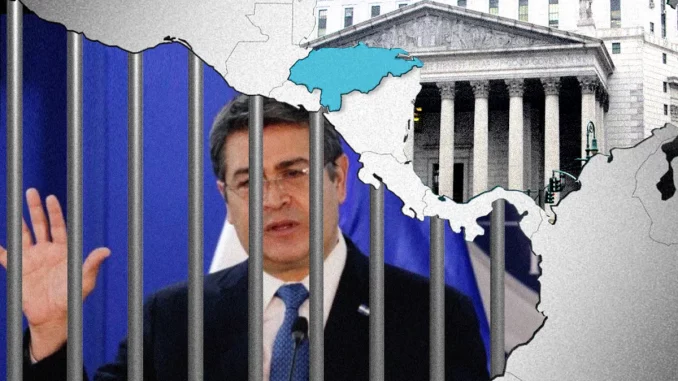
Donald Trump’s pardon of Juan Orlando Hernández, the former president of Honduras, toppled the capstone of one of the most ambitious narcotics investigations in the history of the Department of Justice.
Part 1: The Opening Salvo (2009-11)
Julián Arístides González was up before dawn, grinding the coffee beans he’d grown from seedlings in his front yard. His wife, Leslie Portillo, was already dressed, and his daughter, Giulliana, needed to stir soon. She was catching a ride with him to high school, and his rule was firm: on the road by 6:30, not a minute later.
Julián ran a shower in the upstairs bathroom. Leslie called to him from the hall: “I’m leaving!”
She was one of the first female officers in the Honduran military, and she’d been leaving early all week to take exams required for a promotion. Julián had been an army man himself, enlisting when he turned 16. He rose to the rank of brigadier general before returning to civilian life and accepting the job as director of the Honduran agency fighting drug trafficking.
He’d been traveling more than he liked, spending days at a time on drug raids in northeastern Honduras, the so-called Mosquito Coast. He and his agents were trying to catch planes as they landed at the clandestine airstrips drug smugglers had sliced into the rainforest. Honduras was fast becoming a major narcotics hub, with several rapidly expanding cartels moving cocaine from Colombia and Venezuela into America. A couple months earlier, one of González’s airstrip busts netted 10 accomplices working for the cartels: members of the Honduran national police force.
Five minutes later, González was circling a roundabout when a gray van braked in front of him. At the same time, a green SUV crowded his rear bumper. A motorcycle carrying two men emerged on his left. A man on the back of the bike fired six shots through the driver-side window. González’s head slumped toward his shoulder, and he tilted forward, held upright by the seatbelt. He died instantly.
More than a dozen men streamed out of the two vehicles that had sandwiched his Nissan. They scrambled to collect the spent shell casings on the ground, then scattered other casings across the pavement—decoys to complicate ballistics tracing. They jumped back into their vehicles, circled the roundabout and took the same road Julián had just driven down.
When they approached the Slaughterhouse, the gates opened to let them in, then closed behind them.
The national police officials who killed Julián González on Dec. 8, 2009, had gathered eight days earlier in the office of the department’s top commander. None of them knew that weeks before, an internal affairs unit had hidden a small video recorder in that same office. It captured every word they said.
“Do we have the gunmen yet?”
One of the commanders answered yes, they’d identified four potential assassins to kill González. Officers had been studying his morning routine, tracking his commute, noting his unerring consistency. Everything was going as planned, but another commander warned that everyone needed to keep their mouth shut. If one person got in trouble, he said, they’d all go down. “We all know each other here,” he said. “We know what awaits us.”
The evening before the murder, several of those same commanders returned to the office, where they opened a duffel bag containing $250,000. They counted out $20,000 to set aside for the triggermen, then divvied up the rest for themselves. A short while later, two of the top commanders spoke on the telephone to a cartel boss who’d helped pay for the hit. “Pay attention to the news tomorrow,” one told him. “Tomorrow we do everything.”
In the days after the murder, the department’s internal affairs unit collected the footage of the planning sessions. An officer prepared a detailed report, complete with transcripts of the recordings and interviews with traffic police and other witnesses to the murder.
But soon after it was prepared, that entire package—the recordings, transcripts and interviews —vanished. It would remain hidden for six and a half years.
“Everyone knows who killed my husband. But no one is brave enough to say it”
At Julián’s funeral, those same police commanders expressed their deepest condolences to Leslie and Giulliana. But Leslie knew that Julián had been investigating the chief of detectives, who’d now taken charge of his murder investigation, for allegedly working with drug cartels. As Giulliana stood over the casket, she slipped a letter to her father inside. She wrote that she’d take care of her mom, that she’d see him in heaven and that he’d given her more love in 17 years than most people get in a lifetime.
Back at the house, Giulliana discovered her father had also left letters for her: an oversize scrapbook hidden in his desk, full of diary entries addressed to her, scrawled in tightly coiled cursive. “My dear daughter,” he’d begin, or, “My little baby.” The first entry was written when she was 4 years old. Some of the most recent were composed during stakeouts shortly before his death.
In that same home office, Giulliana and her mother also found lots of Julián’s work files, including many that seemed to identify drug dealers and their suspected connections to Honduran public officials. Leslie thought of turning the files over to the national police, then changed her mind. Julián had always had a good relationship with the American Embassy, she remembered, and he’d said he trusted some of the people there more than those in his own government. So she and Giulliana drove to the embassy and handed the files to the ambassador.
Shortly after, their lives, already shattered by grief, veered into the realm of nightmare. The front gate of their house was guarded by a dog—a rottweiler named Kovu that Julián had rescued from a drug raid years earlier. One day they discovered Kovu stabbed to death at the gate.
They began to suspect they were being followed. Giulliana’s fear quickly turned to anger and defiance. As her mother drove, she’d turn to take pictures of the vehicles trailing them. At first she was discreet, but then she began using a flash to try to send a message: “I know you’re there. I know you’re following me.”
On a Saturday afternoon two months after her husband’s murder, Leslie was driving her pickup truck on one of the busiest avenues in Tegucigalpa when she noticed a motorcycle attempting to pass her on the right. Seeing no right-hand exit for the motorcycle to take, fear flooded her. She couldn’t swerve to the left because of oncoming traffic, so she accelerated—just as bullets pierced her passenger side window. She wasn’t injured, but the shooting shook her to the core.
Activities that once felt normal were now terrifying: driving to work, shopping, picking up Giulliana from school. In 2010, Giulliana moved to the US to attend Georgetown University. Leslie lobbied hard for a transfer to a post at the Honduran Embassy in Washington, DC. A friend at the American Embassy assured her she’d be approved for a visa, but the Honduran officials in charge of securing it told her the process had been delayed. She didn’t believe them. She’d begun hearing rumors—credible ones, from people who’d worked closely with Julián—that the national police had killed him. She began to feel as if her own gouvernement was just as dangerous as the drug traffickers they blamed for her husband’s murder.
In late 2011 one of Julián’s anti-drug-force colleagues, Alfredo Landaverde, appeared on a television news program and named the police commanders he believed had orchestrated Julián’s murder. Leslie called into the same news program, and she made a plea for justice. “Everyone knows who killed my husband,” she said on-air. “But no one is brave enough to say it.”
About two hours after that interview, Landaverde was driving downtown when a now-familiar scene repeated itself: a motorcycle, a gunman and multiple shots through the side window.
Because of the public accusations that immediately preceded it, Landaverde’s brazen murder galvanized Hondurans, who demanded government accountability. Politicians promised reform within the national police. Six days later, Leslie and Landaverde’s widow together visited the office of the Honduran attorney general, urging him to follow through with genuine investigations.
A short time later, the two women received invitations from a congressman, asking them to speak to the national legislature.
The congressman presented himself as their advocate, a dedicated crime fighter who’d combat drug trafficking, pluck the bad apples from the country’s law enforcement system and “regain the trust and credibility of the Honduran people.” His name was Juan Orlando Hernández.
Part 2: Our Friend in Honduras (2012-14)
IN FEW DAYS !!