
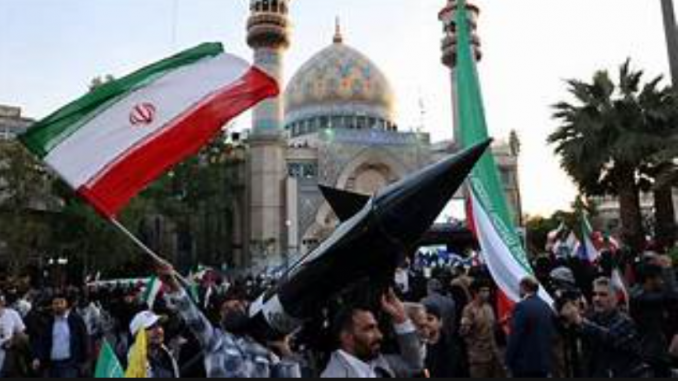
The attack launched on Iran by the US and Israel on 28 February was a textbook case of international aggression, justified in only the most cursory fashion by fictional Iranian threats and undertaken with no clear aims and no clear demands or terms. In announcing the war Donald Trump described it as a wholesale attack on both government and state. The US and Israel would ‘raze their missile industry to the ground’ and ‘annihilate their navy’. Benjamin Netanyahu called on Iranians to ‘come out to the streets and finish the job’. The first week of operations was conducted with characteristic disregard for civilian casualties. Among the targets hit with airstrikes were medical facilities, the state broadcaster and a school. An Iranian frigate not engaged in combat was sunk in international waters with its crew. The official nomenclature matched the sense of euphoric violence emanating from the war itself: the US christened its campaign Operation Epic Fury; Israel chose Lion’s Roar.
The attack was loudly telegraphed. The US military spent six weeks moving planes to regional bases and ships to local waters. Two aircraft carrier strike groups, one from East Asia and one from the Caribbean, were moved to the mouth of the Persian Gulf and the eastern Mediterranean. Trump described the naval force as an ‘armada’ heading for Iran. In the weeks before the beginning of the war, the US air force moved hundreds of fighter aircraft and cargo planes to the Gulf and to Muwaffaq Salti Air Base in Jordan. The combined forces reached a size not seen in the Middle East since 2003. Meanwhile US allies – France, Germany, the UK – deployed ‘defensive’ aircraft to Qatar and the UAE. With the flotilla almost complete, Iranian diplomats and the speaker of Iran’s parliament repeated that Tehran was ready to negotiate with the US. Hours before the bombing started, Oman’s foreign minister, who had hosted a round of negotiations on 26 February, said Iran had agreed to essentially all the US terms. It didn’t matter: on the morning of 28 February, the air and cruise missile strikes began.
On the first day of the war, airstrikes on the central government compound in Tehran killed Iran’s supreme leader, Ali Khamenei, along with the commander of the Islamic Revolutionary Guard Corps, the national security adviser, the chief of staff of the armed forces and the minister of defence. The CIA and Israeli intelligence both leaked information to international media celebrating the way they had cleverly tracked the Iranian leaders to the site. Mossad claims it hacked traffic cameras, bragging that ‘we know Tehran like we know Jerusalem.’ But no particular cunning was needed to choose government headquarters as a target for Israeli F-15s. The chairman of the US Joint Chiefs of Staff, Dan Caine, said the first American strikes were conducted by the navy, using sea-launched Tomahawk missiles. The US air force then quickly established air superiority, allowing long-range bombers free rein over most of Iran. Pete Hegseth, the US secretary of war, said the combined effect of the early strikes was to ‘cut off the head of the snake’.
The Pentagon claims it is ‘prioritising locations that pose an imminent threat’, especially Iran’s missile sites and grounded drones. Many of Iran’s ballistic missiles are stored in hardened facilities that the US air force hopes to entomb. But most are designed to be launched from trucks that can easily be moved. There appears to have been some division of labour between the US and Israeli air forces. The US has been responsible for large military targets. The Israeli air force is focused on political targets and Iran’s internal security apparatus, including police stations, the headquarters of the IRGC in Tehran and the command centres of the Basij militia. There have also been attacks on civilian targets, such as the headquarters of the state broadcasting company. In at least one case, US or Israeli planes struck a hospital. On the first day of the campaign an airstrike on a school in Minab that happened to be next to an IRGC naval compound killed 165 girls between the ages of seven and twelve. It is most likely to have been carried out by the US.
Evaluating the scale of the damage the Iranian state has incurred is difficult. By 3 March, the US military said it had struck 1700 targets, including air defence installations and military communications facilities. That day, the US bombed Bandar Abbas, Iran’s southern fleet headquarters and the navy’s largest port. On 4 March, it sank the Iranian frigate Dena off the coast of Sri Lanka as it returned from a multilateral naval exercise in India that was mostly a diplomatic mission. All but 32 of its 130 crewmen were killed. In total the US claims to have sunk more than twenty Iranian ships and says it will continue ‘sinking the Iranian navy – the entire navy’. The head of US Centcom, Admiral Brad Cooper, described the first 24 hours of the campaign as double the scale of the ‘shock and awe’ campaign in Iraq in 2003. American officials keep warning that a higher-intensity stage of the air onslaught awaits.
In response, Iran has launched a major counterattack using one-way drones and ballistic missiles. The US military claims Iran is indiscriminately targeting civilians in Israel and the Gulf. It’s true that Iran has attacked civilian infrastructure, but it hasn’t been indiscriminate. Its first targets were regional military radar installations designed to track ballistic missiles. It struck satellite communications terminals at the headquarters of the US Fifth Fleet in Bahrain. In Qatar, it hit a ballistic missile early warning system at Al Udeid Air Base, Centcom’s main forward operating base in the region. Al Dhafra Air Base, south of Abu Dhabi, which hosts the 380th Air Expeditionary Wing, has suffered damage. In Jordan, Iranian strikes destroyed the transportable radar accompanying a THAAD (Terminal High Altitude Area Defence) missile system. In Kuwait, satellite installations at Camp Arifjan and Ali Al Salem Air Base have been attacked and six American soldiers were killed at the port of Shuaiba.
US military sites in the Gulf are natural targets because most of Iran’s arsenal comprises short-range missiles, and because the core American regional interest is its military protectorate over the Gulf Arab monarchies. In the first three days of the war, Iran fired 175 ballistic missiles at the UAE, around 100 each at Bahrain and Kuwait, 65 at Qatar and perhaps a dozen at Jordan. It struck the evacuated US embassies in Riyadh and Kuwait City and the US consulate in Dubai, as well as hotels in both Dubai and Bahrain, on the grounds that it was legitimate to target ‘any location hosting Americans’. But it also appears to have attempted to strike civil sites that have no particular association with the US. In Qatar, Iranian missiles and drones struck a power station and the world’s largest liquid natural gas plant. Iran’s missiles, judged by their performance in past strikes, are much less accurate than those in American or European stocks. Some civilian sites were hit by debris from interceptions. But others appear to have been targeted directly. Iran’s foreign ministry claimed that an attack on the port of Duqm (which also hosts a small British military base) on 3 March was a mistake, but Iranian forces later appeared to have hit the port again.
Iran has smaller stocks of the longer-range missiles required to strike Israel; it has launched missile salvos on each day of the war so far, though most have been intercepted. At first it held back from targeting Saudi Arabia, which has by far the largest stocks of Patriot and Talon interceptor missiles in the region. But Iranian drones, a poor target for those systems, got through at Prince Sultan Air Base, a hundred miles south-east of Riyadh. On 2 March, the Ras Tanura refinery on Saudi Arabia’s east coast caught fire after it was hit by debris from an intercepted Shahed drone; it was attacked again on 4 March, this time without damage. This incident aside, Iran has refrained from targeting the region’s oil infrastructure.
The deaths of so many Iranian senior leaders on the first day of operations is undoubtedly damaging to its war effort. But the basic structure of the leadership appears intact. After Khamenei’s death, overall control passed to a three-member Interim Leadership Council: President Masoud Pezeshkian, Chief Justice Gholam-Hossein Mohseni-Ejei and Alireza Arafi of the Guardian Council. The influential speaker of parliament, Mohammad-Bagher Ghalibaf, is still alive, as are Ali Larijani, the head of the Supreme National Security Council, and his brother Sadegh Larijani, chairman of the clerical Expediency Discernment Council. The reviled chief of police, Ahmad-Reza Radan, lives. No member of the Guardian Council has yet been confirmed killed.
US intelligence was well aware that an attack on Iran would provoke a significant response. The Office of the Director of National Intelligence told Congress in March 2025 that ‘Iran’s large conventional forces are capable of inflicting substantial damage to an attacker, executing regional strikes and disrupting shipping, particularly energy supplies.’ As the US began its military build-up, Iranian leaders made their position clear. In January, Ghalibaf said that ‘in the event of a US military attack, both the occupied territories and US military and shipping centres will be legitimate targets for us.’ On 1 February, Khamenei said that the US ‘must know if it starts a war this time it will be a regional war’. After the war did begin, an Iranian government official told the Financial Times correspondent in Tehran that Iran ‘had no choice but to escalate and start a big fire so everyone would see’.
It is tempting to frame the attack of 28 February as a spectacular aberration, an act of criminal aggression that could only take place in the age of Trump and Netanyahu. But for the US, the war is the culmination of a long history of coercive pressure and diplomatic isolation of Iran. In his first public address about the operation, Hegseth claimed the US objective was ‘the elimination of a threat that has existed since 1979’. Under the shah, the US had been able to count on Iran to serve as what a past generation of American planners called ‘its chief regional proxy’. After the revolution, Iran went from ‘staunch ally to implacable foe’. During the Iran-Iraq War, the US provided support for the Iraqi offensive in the hope of destabilising the revolutionary government. Despite incurring hundreds of thousands of casualties, the revolutionary regime survived as a stain on the otherwise enviable American position in the Persian Gulf. In 1997, two former US national security advisers, Brent Scowcroft and Zbigniew Brzezinski, noted that after Operation Desert Storm, Iraq remained a threat to US dominance of the Gulf, but ‘Iran represents a geopolitical challenge of far greater magnitude and complexity.’
After the invasion of Iraq in 2003, parts of the American national security bureaucracy pushed for a similar solution in Iran. The 2006 National Security Strategy celebrated success in Iraq, before declaring that the US ‘may face no greater challenge from a single country than from Iran’. The authors charged the Iranian government with sponsoring terrorism, threatening Israel, thwarting peace in the Middle East and ‘disrupting democracy in Iraq’. In the event, the US was sufficiently chastened by its experience in Iraq that it didn’t attempt military confrontation. Instead, it adopted a strategy of financial blockade, initiated under George W. Bush in 2006, greatly expanded from 2011 under the Obama administration and only partly relieved during the two years (2016-18) of the Iran nuclear deal. Throughout the blockade, the US conducted covert actions and sabotage inside Iran, often with Israel’s help, the most striking result being the assassination in January 2020 of Qasem Soleimani, commander of the IRGC’s Quds Force.
The US girded its case for international aggression against Iraq by falsely claiming there was ‘irrefutable proof’ the government was seeking to add nuclear weapons to its arsenal of WMDs. Unfortunately for the Trump administration, that tactic wasn’t an option when it came to Iran. In 2026, the official assessment of US intelligence remains that Iran has no nuclear weapons programme. As the Office of the Director of National Intelligence put it in its report to Congress, ‘we continue to assess Iran is not building a nuclear weapon.’ Claims by American leaders that Iran must be prevented from having a nuclear weapon – ‘by any means necessary’, as Marco Rubio put it – can have nothing to do with the rationale for war except as emotionally potent misdirection. A more plausible immediate motivation for the war was vulgar opportunism. The brutally repressed January protests, the largest in a series of protest movements, had revealed the Islamic Republic to be deeply unstable. It was losing the support of regional allies. And it had revealed itself to be vulnerable militarily: its missile strikes against Israel in April and October 2024 didn’t display great precision, and the US and Israel had effectively destroyed its air defences in the campaigns of 2024 and 2025.
In the first days of the war, Trump described ‘what we did in Venezuela’ as the ideal scenario for Iran. Trump may imagine a repeat of Caracas but the situation is entirely different, and not just because Iran still has the military capacity to inflict at least some local pain. With Nicolás Maduro out of the way, the US could count on his deputy, Delcy Rodríguez, for compliance. Masoud Pezeshkian, now part of the interim ruling triumvirate, was never going to play that role. Reza Pahlavi, son of the last shah, has given a long audition as exiled saviour ready to be spirited to the capital. But it’s difficult to imagine the US telling him to get on a motorcycle in Sulaymaniyah and ride into Iran to meet a CIA security team in Kermanshah, as it in effect did for Hamid Karzai in Afghanistan. The day before the attack, Pahlavi held a press event in Washington DC, where he was joined on stage by supposed representatives of Iranian ethnic minorities – Kurds, Baluch, Arabs, Azeris, one wearing what appeared to be a Qajar-era hat – in an effort to present himself as a unifying national figure. During the January protests there was evidence of some interest in monarchism. But Pahlavi’s personal ambition for an American-assisted restoration remains far-fetched.
Whether the US has the appetite for a long war remains an open question. The White House has told tame American journalists that the CIA evaluated several scenarios: a chaotic uprising, a palace coup by the IRGC or the emergence of another ruler from the clerical establishment. These scenarios all assumed the IRGC would continue to be a pre-eminent force. US intelligence knows that even if it shatters the central state there is no politically coherent national opposition. With the military and security apparatus weakened, the likelihood increases of Baloch and Kurdish insurgencies, even Azeri separatism – and who is to say that isn’t the intention? The Iranian government made token efforts to ease minority grievances – in 2024 an ethnic Baloch was appointed governor of Sistan-Balochistan, and an ethnic Kurd governor of Kurdistan province – but that didn’t stop Kurdish and Baloch groups taking part in the January protests.
There are signs that the US is trying to tip the scales. There have been airstrikes on IRGC and police headquarters in Marivan and Sanandaj, where some of the units tasked with quashing Kurdish protests are based, and the Baloch People’s Fighters Front has already engaged in attacks on Iranian security forces. Reports in the American media that the CIA is working on a plan to arm Kurdish auxiliaries in the north-west are concerning, but it’s hard to know how much weight to give anonymised quotes from the present White House. Six days before the US-Israeli attack, a new political organisation of Iranian Kurdish groups calling itself the Coalition of Political Forces of Iranian Kurdistan sprang up. Trump personally spoke by phone with the president of the Democratic Party of Iranian Kurdistan, Mustafa Hijri. Whatever designs the US may have are complicated by the fact that one of the largest Iranian Kurdish formations, the Party for Free Life in Kurdistan, has been under US sanctions since 2009. On 1 March, Trump also placed phone calls to Masoud Barzani and Bafel Talabani, leaders of the main parties in Iraqi Kurdistan. But it’s unlikely that Iraqi Kurdish forces would be willing to play a significant role in the conflict unless there were a clear collapse of Iranian state authority.
The war has been accompanied by exaggerated claims that it is widely supported by Iranians. Predictably, an influential segment of the Iranian diaspora in the US pushed strongly for the attack. Diaspora dynamics are easy to caricature, but there’s no question that part of the Iranian diaspora in North America and Western Europe has traded political action against the injustices of the incumbent Iranian system for nostalgic monarchical fantasies and a dream of external deliverance. The political scientist Mojtaba Mahdavi, himself an academic abroad, has described Iranian diaspora agitation for foreign military intervention as the sorry consequence of an abandonment of principled political opposition. In the US, professional diaspora politics is a lucrative game wherever the players are willing to align with American imperial interests.
By contrast, the organised domestic opposition, which for the most part is either incarcerated or forced to keep a very low profile, has tended to be strongly against external military intervention. Mir-Hossein Mousavi, an opposition leader under house arrest (and sometimes more) since 2009, has consistently spoken out against it. On 3 March, a statement published by Haja, a secular and republican opposition group, condemned ‘the military aggression by the United States and Israel’ and described Khamenei’s assassination as an escape from justice. Reformist figures in Iran responded to the attack with a sense of defeat. As the airstrikes began, Ahmad Zeidabadi, a prominent journalist who was imprisoned after the 2009 presidential elections, described his fears of a ‘devastating war that will inflict enormous losses on our region’. Mohammad Taghi Karroubi, the son of the prominent reformist cleric Mehdi Karroubi (also under house arrest), called the attack an act of ‘despicable aggression’. Even in the diaspora opposition, the attack doesn’t have universal support. The human rights lawyer Mehrangiz Kar, a dissident who spent time in Evin Prison before fleeing into exile and who was once honoured by the US intelligence-linked National Endowment for Democracy, described the war as an attempt to dismantle Iran. ‘They want to hand over a ruined Iran to the Iranians and say: “We have levelled the ground for you – now it’s your turn to build democracy on the ruin.”’
For Israel, the war is the final stage in a grand campaign of regional violence that has already resulted in the destruction of Gaza, deadly raids in the West Bank, mass assassinations of Hizbullah members, incursions into Lebanon and Syria, airstrikes in Iraq and Yemen, and a major aerial attack on Iran last year. Alongside the air campaign, Israeli forces have seized the moment to launch yet another major attack on Lebanon. The Israeli government and its professional advocates in Washington have been making the case for a full-scale American war in Iran for years. On 11 February, Netanyahu visited the White House to discuss it with Trump. It may well be true, as Rubio claimed, that Israeli officials told the White House they planned to attack Iran with or without American help. But to suggest that the US has been led by Israel into a war in which it otherwise had no interest is to ignore US policy towards Iran since 1979 and the emboldening effect of Maduro’s removal. Nor should Israel’s usefulness to American power be dismissed. The National Defence Strategy published in January described the retributive violence in which Israel engaged after 7 October 2023 as proof it was ‘a model ally’.
The war was immediately condemned as a violation of the UN Charter by the special rapporteur Mai Sato. But among America’s main allies it has attracted more uniform support than any major US military action since the invasion of Afghanistan. The UK was initially reluctant to provide the use of its military bases: Keir Starmer claimed his government ‘does not believe in regime change from the skies’. But on the second day of the attack, he agreed to the use of British bases in Gloucestershire and Diego Garcia for ‘defensive strikes’. In a reversal of 2003, European states have been more enthusiastic supporters of a criminal military action than the UK. Chancellor Merz said Germany was ‘supporting the US and Israel to get rid of this terrible terrorist regime’. Countries that claim to oppose unprovoked wars have, with the commendable exception of Spain, welcomed this one.
Predictions about the course of the war should be approached with great caution. Once initiated, international aggression takes on a life of its own. But on a number of points it is possible to have confidence. There will be war crimes. Large parts of a population that was described as awaiting liberation will instead be made refugees. The caricature of a small, bandit leadership ruling over a people held at bay only by violence will have to be discarded. Iranians who now welcome the attack will find that the US cares as much about political freedom in Iran as it does in Saudi Arabia. American and Israeli leaders give conflicting accounts of their goals, and it’s perhaps a mistake to ascribe a conceptual objective to incoherent, raging violence. Perhaps they imagine that the chaotic conditions that will ensue can later be exploited. One thing is certain: they have precipitated a crisis that won’t be confined within Iran’s borders.
Par Tom Stevenson (London Review)