
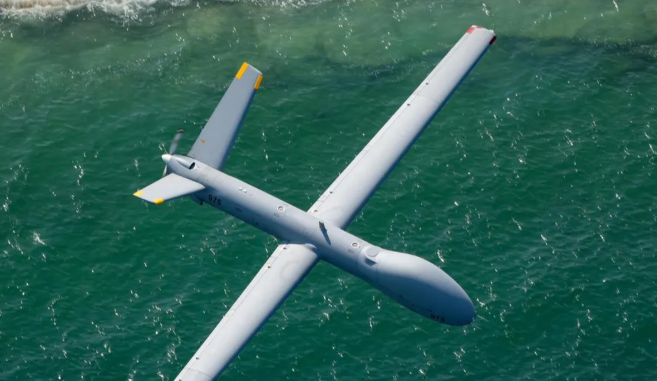
Just weeks after Iran’s proxy struck Abu Dhabi, Israel’s largest arms manufacturer proposed supplying the UAE with a fleet of dozens of strategic drones. Leaked internal documents allegedly reveal the array of weapons systems sold to the Gulf state
On January 17, 2022, the Houthis in Yemen launched an attack on the United Arab Emirates. The attack included a barrage of ballistic missiles and drones, some of which struck oil facilities and Abu Dhabi International Airport. Three people were killed. Two months later – according to leaked documents – Israeli defense contractor Elbit Systems responded to an urgent Emirati request for assistance, drawing up a detailed proposal for the rapid supply of its most advanced drones.
Internal documents from Israel’s largest arms manufacturer reveal discussions about the sale of a wide range of advanced weapons systems to the UAE, shedding light on the close security ties forged between the two countries following the signing of the Abraham Accords.
Those ties have reached new heights in recent months amid the joint war against Iran, including the deployment of Iron Dome batteries on Emirati soil and Prime Minister Benjamin Netanyahu’s secret visit to the country at the height of the fighting.
The internal documents appear to have originated in a leak from the personal Gmail account of a senior Elbit executive who used it for work. They were recently published online by a hacker group linked to Iranian intelligence. Haaretz analyzed the extensive cache and cross-checked its contents against sources and publicly available information. As recently reported here, the documents shed light on sales of advanced weapons systems to Qatar and Saudi Arabia, as well as the artificial intelligence capabilities of the drones used by the Israeli army in Gaza and Lebanon.
Critical national security, cyber and arms updates, delivered weeklySign Up
The proposed sales to the UAE were reported last week by Drop Site News. The alleged drone sale is part of a series of major deals between Israeli arms manufacturers and the Abraham Accords countries – the UAE, Bahrain and Morocco – that are rarely officially disclosed. Elbit, Rafael, Israel Aerospace Industries and other companies have opened local offices and established joint ventures with Emirati defense firms, while sales to the country have continued to soar.
– Advertisement –
Israeli defense exports reached another record in 2025, totaling $19 billion, including some $3 billion in sales to Abraham Accords countries. Since 2021, Israeli arms sales to those countries have totaled approximately $9 billion, the overwhelming majority going to Morocco and the UAE.

The leaked documents include correspondence among senior Elbit executives, including CEO Bezhalel Machlis; Executive Vice President for International Marketing and Business Development Ran Kril; Executive Vice President for UAVs and Strategic Affairs Haggai Topolansky; Executive Vice President for Strategy and Business Development Michael Edelstein; Aerospace Division General Manager Yoram Shmuely; Vice President for UAV Systems Vered Haimovitz; and others.
The correspondence points to lax information-security practices: The email threads show that documents containing sensitive information were sent from the private email accounts of at least two senior company executives rather than through Elbit’s corporate email system.
One document from 2021 summarizes a meeting between Elbit’s CEO and the head of the Israeli Defense Ministry’s Political-Military Bureau. The two discussed the possible sale of various weapons systems to several countries, including Qatar, Saudi Arabia, Ethiopia, Rwanda and Turkey. According to the document, Elbit was authorized to sell the UAE an intelligence-gathering Hermes 900 drone without strike capabilities, as well as the SkyStriker loitering munition, limited to a range of 60 kilometers.
The meeting also addressed the possible sale of MPR-2000 bombs – one-ton munitions designed to penetrate bunkers and fortified structures.
The documents show that the UAE submitted an « urgent operational requirement » to Elbit for an initial supply of six Hermes 900 drones. The Hermes 900 is Elbit’s most advanced drone and entered operational service with the Israeli army more than a decade ago. It can carry various intelligence-gathering systems with a combined payload of up to 350 kilograms. As was cleared for publication in Israel in 2022, the drone is also used to carry out strikes. According to foreign reports, it can carry up to eight air-to-surface missiles.

The correspondence shows that in March 2022, the then-head of R&D at MAFAT – the Israeli Defense Ministry’s arms development directorate – was preparing to travel to the UAE to discuss what were described as « two air-defense projects. » Ahead of the visit, a sales proposal was prepared for Hermes 900 systems intended to provide the UAE with « an operational solution for maintaining surveillance beyond the country’s borders – detecting missile and drone launches into the country, » as well as for homeland security (HLS) needs within the UAE.
By the end of that month, Elbit had drawn up a detailed proposal for two « Hermes 900 intelligence-gathering systems, » each comprising three aircraft and a range of intelligence equipment. Under the proposal, Elbit would supply a total of six drones fitted with six electro-optical surveillance payloads for day-and-night observation, three SkyEye WAPS payloads, three cellular interception systems, three electronic-warfare systems and three LightSpear systems designed to protect the drones against interception and jamming. The package also included two ground-control stations.
SkeEye WAPS is a specialized payload, mounted beneath the Hermes, which comprises an array of 10 electro-optical cameras that allows a single drone to record a vast area in real time and at high resolution. It also provides what the documents call « intelligence forensics » – the ability to rewind footage in real time while integrating multiple viewpoints. This makes it possible to trace a particular object back to its point of origin or reconstruct a sequence of events after the fact.
The proposal sent to the Emiratis priced each drone system at approximately $90 million. But that was only the beginning of the partnership. The documents show that the UAE wanted to expand the Hermes deal to 15 systems, a fleet of 45 advanced drones. A deal of that scale would be worth roughly $1.3 billion.

Another Emirati document, marked classified, was attached to one of the leaked email exchanges. Titled « SIGINT Wish List », it set out a requirement for four Elbit-made intelligence aircraft equipped with electronic-intelligence collection systems, communications-interception capabilities, cyber and electronic-warfare systems, and visual-intelligence capabilities. The documents do not make clear whether the sale went ahead.
The leak contains a 2nd reference to the SkyStriker loitering munition – which Elbit documents say is known in the Israeli army as « Red Galloper ». A presentation attached to another leaked email briefly reveals a further deal with the UAE, codenamed « Yasmin 3, » to manufacture « 6,000 kits within three months. » It is unclear what type of kit was involved, but Elbit produces, among other products, kits that convert « dumb bombs, » such as the MPR-2000, into precision-guided munitions using GPS or laser guidance.

The documents also reveal a proposal to sell the UAE another strategic system: the Hermes 650, the newest drone in Elbit’s fleet. A sales presentation dated March 2023 offered the new drone to the Emiratis nearly a year before it was officially unveiled at the Singapore Airshow. The Hermes 650 can carry a wide range of signals-intelligence, surveillance and electronic-warfare systems, among others. It is expected to gradually replace the Hermes 450 – the Israeli Army’s veteran workhorse, which will soon mark 30 years of service as an intelligence-gathering and strike drone.
One line in the presentation assures the Emiratis that the Hermes 650 is interoperable with Elbit’s SkyStriker and Aeronautics’ Orbiter-series drones (Aeronautics is owned by another Israeli arms giant, Rafael). This may indicate that these systems had also already been sold to the UAE. The presentation offers the Emiratis a comprehensive strategic solution that includes the local production of various components, including engines, as well as the local integration of systems, in line with the UAE’s policy of developing an independent defense industry.

The only time Elbit publicly announced a deal with the UAE was in January 2022. Under the $50 million contract, the UAE’s five aerial refueling aircraft were equipped with Elbit-made missile-defense systems. Last November, Elbit announced a $2.3 billion deal to supply a « strategic solution to an international customer » – one of the largest arms deals in Israeli history. Neither the customer nor the systems sold were disclosed. A single report in a French magazine identified the UAE as the customer.
Emirati Airlift
Security ties between the two countries have only deepened since then. After Israel and the United States launched their attack on Iran on February 28 this year, Iran directed the bulk of its response at the UAE – and launched over 3,000 ballistic missiles and drones at it.
Israel once again came to the aid of its Gulf ally. According to reports and flight tracking data, Emirati aircraft landed in Israel, usually late at night. The flights could not be reported at the time. Two weeks later, however, Axios revealed that Israel had dispatched Israeli army Iron Dome batteries to the UAE, along with their crews. U.S. Ambassador to Israel Mike Huckabee and Israeli security cabinet member Miri Regev confirmed the report. The Financial Times reported that Israel had also transferred a laser-interception system to the country.
A similar Emirati airlift landed at Israel’s Nevatim airbase in April 2022. Several months later, satellite imagery revealed that an Israel Aerospace Industries Barak air-defense system had been deployed around Al Dhafra Airbase, south of Abu Dhabi. At the same time, Reuters reported that the UAE had purchased Rafael’s SPYDER air-defense system.
In a conversation with Haaretz, a senior U.S. official praised the relationship between Israel and the United Arab Emirates that has developed since the signing of the Abraham Accords, emphasizing that the United States is pleased to have two such partners in the Middle East.
He stressed that the unique relationship between the two countries has enabled the UAE to carry out humanitarian projects in Gaza that were not possible for other countries or for UN agencies—for example, the construction, in the midst of the war, of a pipeline to transport desalinated water from Egypt into the Gaza Strip.
« The Emiratis are the only ones who work things out directly with Israel and don’t come to me to solve their problems, » the senior U.S. official said, referring to the entry of humanitarian aid that is classified—or could be classified—by Israel’s security services as intended for « dual use. »
In response to a Haaretz request for comment, Elbit said that it « does not comment on the business matters relating to its customers. The mentioned data does not reflect the firm’s business reality. »