
The role of Lithuania in supporting Ukraine is difficult to overestimate. A steadfast and principled ally, Lithuania has provided assistance amounting to nearly 2% of its GDP – one of the highest levels of support in the world, exceeded only by two countries.
Lithuania was among the first countries to supply Ukraine with lethal weapons, delivering millions of rounds of ammunition, assault rifles, and other arms to replace Soviet-era stockpiles. The first packages of Lithuanian military aid arrived in Ukraine as early as Feb. 27, 2022 – on the third day of Russia’s full-scale invasion – at a time when many countries expected Kyiv to fall within days or weeks.
With the backing of the Lithuanian government, the Create Ukraine initiative was launched, bringing first ten and later another 25 highly qualified young professionals back to Ukraine from Europe and the United States. Lithuania has also assumed responsibility for financing the reconstruction of schools and kindergartens in deoccupied territories, modernizing hospitals and other public institutions, assisting citizens in rebuilding destroyed housing, and constructing underground schools and shelters.
Advertisement
Crucially, Lithuania’s approach to reconstruction goes beyond simply restoring what was lost. Its goal is to help create a new and higher quality of life – one based on modern standards, sustainability, and resilience.
Other Topics of Interest
Russian Parents Pull Children From Schools Amid Rising War Propaganda
Nearly 100,000 children in Russia are now educated at home, with officials’ data showing a sharp rise since the invasion of Ukraine and the expansion of ideological programs in schools.
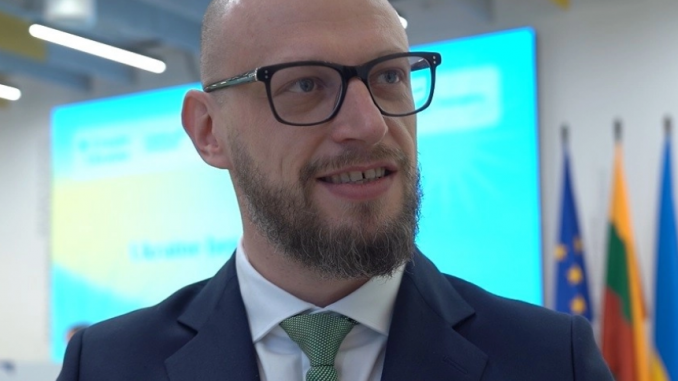
We discuss these projects and the principles behind them with Arturas Žarnovskis, Program Manager for Ukraine Reconstruction Programs of the Lithuanian government.
- Tell about your work experience in Ukraine, in restoration and rebuilding. How it goes?
It started even before 2022, before the full-scale invasion. We started our first projects in Avdiyivka, which is temporarily occupied. But we gained a lot of experience in operating quickly, and we made the decision to act fast in 2022, when it was not yet obvious that rebuilding should start now rather than wait for the end of the war. The first projects were just schools and kindergartens in deoccupied territories, and then it became more systematic. We have a strong focus on education and rehabilitation of Ukrainian defenders and those affected by war. The question was how to adapt European standards to the reality of Ukraine, not just copy them.
Advertisement
- How much have you invested in Ukraine?
In total, since 2022, it is more than 1.6 billion euros. It is all together: governmental support, including military and energy assistance. Lithuanian society strongly believes in Ukraine, that the success of Ukraine is a success for Lithuania. For sure, it is also a question of security.
- What is the concept of your work?
We understand that we are a small country, but we try to do a lot. First of all, it is cooperation. We, Lithuanians, know well that it is impossible just to copy another experience. We make decisions together with Ukrainian authorities. Also, we scale the projects. Projects need not only to be good, but also scalable for the government and other donors. We believe that strong institutions, rehabilitation of soldiers, and good education are the keys to Ukraine’s success. Now we have three rehabilitation centers under reconstruction in Lviv, Dnipro, and Zhytomyr, and six underground schools in process. They will be opened this year in Dnipro, Sumy, and Mykolayiv. We want to concentrate not only on the Kyiv region, but also on areas closer to the frontline. It is coordinated with the Ministry of Education, but financed by Lithuania and the EU.
Advertisement
- How will it be different from how it was before?
It is a very new way of education. We understand that to build back better is the minimum. But we did it for inspiration. For instance, our project the “Future School for Ukraine” in Zhytomyr school shows us that it can be not only just a school, but also inspire systematic horizontal changes in Ukraine. It should be an acceleration of much bigger things.
- How will it differ from a Soviet school?
We took the best architects from Ukraine and Europe, the best educational specialists, and people involved in decision-making, and spent a lot of time discussing what it would look like and developing the concept, because it is impossible just to copy it from Finland, for example. How it serves the spaces, security, catch-up education. Then we made a global architectural competition for the best solution. Architecture serves the process itself, it inspires the educational process. It will serve for decades. So, the next generations will have better education than we have today. In Zhytomyr, it is built on adaptive technical design. It can be repeated in other places. This can save time and money. It is like LEGO: you have the same pieces, but you can build and construct differently, play with them.
Advertisement
- What does Ukraine need for quick transformation?
A good example inspires. Sustainable economic logic, reduced energy losses, inclusiveness. The building should be used all day, not only as a school. Different tasks for the community. It should function as a community space after lessons. Social functions, a public place. So, we need to serve it as a multifunctional center, because after the war Ukraine will also have difficulties with infrastructure. A place where people can be together.
- After Donald Trump was elected US president, we hear about isolationism, lack of help for Ukraine, etc. Why is it necessary to provide more help to Ukraine from the civilized world now?
These four painful years have shown us that Ukraine is the only country that can resist barbarism. I cannot see a successful Europe, and even more, a successful world, without a successful Ukraine. There is no other way. For us, Ukraine is obviously a key element of a successful Lithuania. When we talk about Ukraine in the EU… it means that its not only for Ukraine! EU also needs it!